
The motor gets much of the attention when people talk about electric scooter performance.
But the motor does not operate by itself.
Between the battery and motor sits one of the most important electronic components in the scooter: the controller.
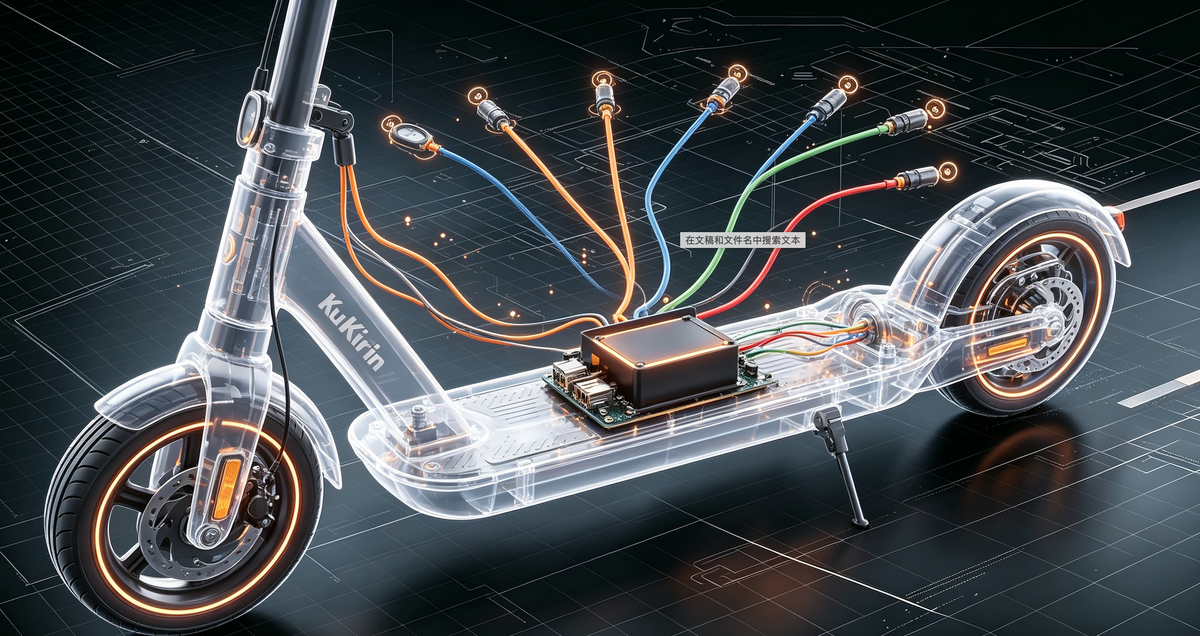
The controller receives information from the rider, manages electrical power, and controls how the motor responds.
For a KuKirin electric scooter, understanding the controller provides a clearer picture of what happens after the throttle is twisted.
1. The Controller Sits Between Battery and Motor
The simplest way to understand the controller is to look at its position in the electrical system.
Battery → Controller → Motor
The battery supplies electrical energy.
The controller manages that energy.
The motor converts it into mechanical rotation.
But the controller also communicates with the throttle.
Throttle → Controller
This means the controller connects rider input with motor output.
2. The Throttle Sends the Rider's Request
When the rider twists the throttle, the throttle sensor generates an electrical signal.
That signal tells the controller that the rider wants acceleration.
A small input and a larger input can represent different requests.
The controller receives the signal and manages the motor response accordingly.
 The rider does not manually control electrical current.
The electronic system handles that process automatically.
3. The Battery Supplies the Energy
The controller cannot create energy.
The battery provides it.
KuKirin models use different battery configurations depending on their design. For example, the G2 uses 48V 15.6Ah, while the G4 uses 60V 20Ah.
The controller manages electrical energy coming from the battery and sends controlled power toward the motor.
This is why the controller must be compatible with the battery's voltage and the scooter's motor system.
4. The Controller Controls Motor Output
Electric motors require controlled electrical input to produce continuous rotation.
The controller manages this electrical input.
In a brushless motor system, electronic switching controls the magnetic fields responsible for rotation.
The controller therefore has to coordinate electrical power with motor operation.
 The entire process happens quickly enough that the rider experiences it simply as acceleration.
5. Controller and Motor Work as a Team
A motor's rated output does not exist independently.
The controller determines how electrical energy is delivered to that motor within the system's limits.
This means the motor and controller need to be considered together.
For example, the KuKirin G2 has an 800W motor, while the G4 is listed with a 2000W motor.
These scooters therefore represent different levels of electrical and mechanical performance, but their real-world behavior still depends on the complete system.
6. What Happens During Acceleration?
When you twist the throttle:
1. Throttle detects input.
2. Controller receives the signal.
3. Controller determines the motor response.
4. Battery supplies electrical energy.
5. Controller regulates power.
6. Motor produces torque.
7. Wheel rotates.
8. Tire generates traction.

This process explains why the controller is so important.
7. What Happens on a Hill?
Hill climbing increases the demand placed on the drive system.
The motor needs to overcome gravity in addition to rolling resistance.
The controller manages the electrical power available to the motor within system limits.
This means that the battery and controller must work together to support the motor.
A scooter's hill-climbing behavior should therefore be considered as a system-level characteristic.
8. Heat and Electrical Load
Electrical components generate heat during operation.
Demanding riding can increase electrical and thermal loads.
Repeated acceleration and long climbs can therefore place more demand on the motor, controller, and battery.
Proper system design and thermal management are important for reliable operation.
Riders should always follow the manufacturer's recommendations for operation and maintenance.
9. Controller Compatibility Matters
A controller is not a universal plug-and-play component.
Replacement controllers should match the scooter's electrical architecture.
Important factors can include:
- Battery voltage
- Motor configuration
- Wiring
- Connectors
- Throttle
- Display
- Current characteristics
- Controller programming
For KuKirin replacement parts, verifying compatibility with the exact scooter model is important.

10. Understanding the Controller Helps You Understand Your Scooter
Once you understand the controller, the rest of the electrical system becomes easier to visualize.
Battery = Energy
Controller = Power Management
Motor = Mechanical Output
Wheel = Movement
Road = Traction
The controller connects the first three stages.
Every time a KuKirin scooter accelerates, the controller is working behind the scenes.
It receives the throttle signal, manages battery power, controls motor operation, and helps transform a rider's command into physical movement.
It may not be the most visible component on the scooter, but it is an essential part of the electronic system.
Throttle → Controller → Battery → Motor → Wheel
Understanding this chain makes it easier to understand how modern electric scooters deliver controlled, responsive performance.
Related reading:
👉 Click to visit our official KuKirin Ride website to view more content.
👉The Spirit Behind KuKirin: Innovation, Freedom, and Sustainable Mobility
👉Hydraulic vs Spring Suspension: Which KuKirin Off-Road Scooter Is Right for Your Adventure?
👉KuKirin G2 (2026 New) Electric Scooter Review
👉The Electric Scooter Controller Explained: The Brain Behind Your Ride
Condividi:
The Electric Scooter Controller Explained: The Brain Behind Your Ride
Why Electric Scooter Weight Matters More Than You Think