
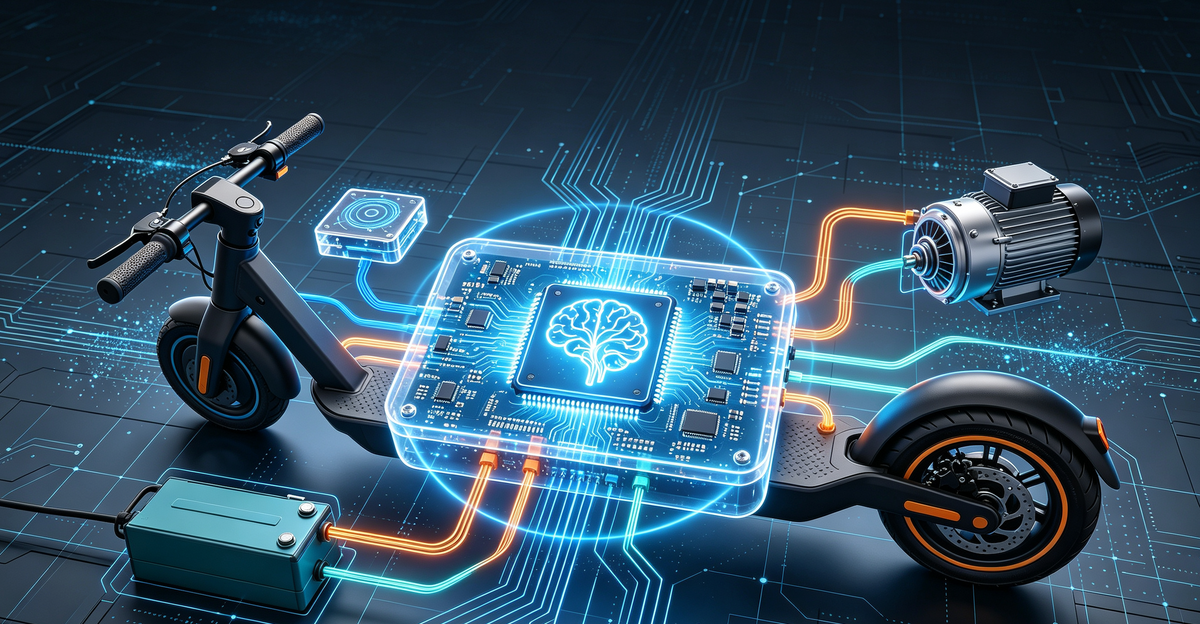
When people talk about electric scooter performance, they usually focus on the motor, battery, top speed, or riding range.
One component, however, often receives much less attention: the controller.
Hidden inside the scooter, the controller plays a critical role in determining how electrical energy is delivered to the motor. It receives signals from the throttle, manages power from the battery, and controls the electrical current supplied to the motor.
Without the controller, the battery and motor would not work together as a coordinated drive system.
So, what exactly does an electric scooter controller do?
To understand it, we first need to look at where the controller sits within the scooter's electrical system.
1. Where Is the Controller?
The controller is usually installed inside the scooter's deck, frame, or another protected compartment.
Its location may vary depending on the scooter's design.
You may never see it during normal riding, but several electrical wires connect it to other important components.
A simplified system looks like this:
Throttle → Controller → Motor
At the same time, the controller is connected to the battery:
Battery → Controller → Motor
The controller therefore sits between the rider's input, the battery's electrical energy, and the motor's mechanical output.
This makes it one of the central components in the entire propulsion system.
2. The Controller Receives the Throttle Signal
Everything begins when the rider uses the throttle.
The throttle detects the rider's input and sends an electrical signal to the controller.
The controller reads that signal and determines what the rider is requesting.
A small throttle input can represent a request for gentle acceleration, while a larger input can represent a request for stronger motor output.
The controller does not simply receive the signal and send the same amount of electricity directly to the motor.
Instead, it processes the request and manages the power delivery.
This is what allows the scooter to respond progressively to throttle movement.

3. The Controller Is a Power Manager
The controller's most important job is managing electrical power.
The battery stores energy, but the motor requires controlled electrical input to operate correctly.
The controller regulates this flow.
A simplified example is:
Battery → Controller → Controlled Electrical Power → Motor
When the rider requests acceleration, the controller manages the electrical current supplied to the motor.
The exact control strategy depends on the scooter's electrical architecture and controller design.
This means that the controller acts as a bridge between available battery energy and the motor's operating requirements.
It is not simply an electrical connection.
It is an active electronic component responsible for controlling the drive system.
4. Why the Controller Matters for Acceleration
Acceleration is affected by the relationship between the throttle, controller, battery, and motor.
Imagine twisting the throttle quickly.
The throttle sends a signal indicating the rider wants acceleration.
The controller receives that signal and determines how the motor should respond.
It then manages the electrical power supplied to the motor.
The motor produces rotational force, and the wheel begins accelerating.

The controller therefore has a direct role in how the scooter responds to rider input.
A well-coordinated control system can make acceleration feel predictable and progressive.
5. How the Controller Works With the Battery
The battery and controller perform very different jobs.
The battery stores electrical energy.
The controller manages how that energy is used by the drive system.
This relationship is important because the motor's electrical demand can change continuously during a ride.
Starting from a stop, climbing a hill, accelerating, and maintaining speed can all create different power requirements.
The controller manages these changing demands within the limits of the electrical system.
Battery voltage and available current are important factors in this process.
However, the controller also has its own operating limits.
This is why battery, controller, and motor specifications need to be considered together rather than separately.
6. How the Controller Controls the Motor
Electric motors require carefully controlled electrical input to create continuous rotation.
The controller manages this process by switching electrical power through the motor's circuits in a controlled sequence.
In a brushless motor system, for example, electronic switching is used to control the magnetic fields that produce rotation.
The controller therefore has to coordinate electrical timing with motor operation.

The process happens extremely quickly.
To the rider, it simply feels like the motor responds when the throttle is twisted.
Internally, however, the controller is continuously managing the relationship between electrical input and motor rotation.
7. What Happens When Motor Speed Changes?
The motor does not operate under exactly the same conditions throughout a ride.
When the scooter starts, the motor is at low speed.
As the scooter accelerates, motor speed increases.
The electrical behavior of the motor changes as its rotational speed changes.
The controller must therefore continue adjusting its control strategy as operating conditions change.
This is one reason why the controller is more sophisticated than a simple switch.
It continuously manages the electrical relationship between the battery and motor while the scooter is moving.
8. The Controller and Hill Climbing
Hill climbing provides another good example of the controller's role.
When the scooter encounters an incline, more force may be required to maintain speed.
The motor needs to produce additional torque to overcome gravity and other resistance.
The controller manages the electrical power delivered to the motor according to the system's limits and the rider's input.
If the rider continues requesting acceleration, the controller responds accordingly.
However, the controller cannot create unlimited power.
The battery, motor, controller, wiring, and thermal conditions all place practical limits on the system.
This is why a scooter's ability to climb a hill depends on the complete drive system rather than the controller alone.
9. Why Controllers Can Become Warm
Electrical components are not perfectly efficient.
Whenever electrical current flows through components, some energy is converted into heat.
The controller can therefore become warm during operation, especially when the scooter is working hard.
Long climbs, repeated acceleration, heavy loads, and demanding riding conditions can increase the workload on the electrical system.
Controller design often includes methods for managing heat, such as a metal housing that helps transfer heat away from internal electronics.

Keeping the controller within its intended operating conditions is important for reliable system performance.
10. What Happens When You Release the Throttle?
The controller also responds when the rider stops requesting acceleration.
When the throttle returns toward its neutral position, the signal sent to the controller changes.
The controller can then reduce the drive power supplied to the motor.
Depending on the scooter's design and settings, the scooter may continue rolling freely, slow through electronic control, or activate an electronic braking function.
Some systems may also support regenerative braking.
In regenerative braking, the motor can operate in a way that sends some electrical energy back toward the battery during deceleration.
The exact behavior depends on the scooter model and its control system.
11. The Controller and Safety Functions
The controller may also work with other electrical signals and protection systems.
Depending on the scooter design, the electrical system can monitor conditions such as voltage, current, temperature, or other operating parameters.
These functions help the system operate within its intended limits.
For example, electrical protection can help respond to abnormal operating conditions.
However, the exact protection features vary between scooter models and controller designs.
This is another reason why replacing a controller should not be treated as simply installing a generic electrical component.
Compatibility matters.
12. Why Controller Compatibility Is Important
Electric scooter controllers are not universally interchangeable.
A controller needs to be compatible with the scooter's electrical architecture.
Important considerations can include:
- Battery voltage
- Motor configuration
- Electrical connectors
- Throttle signal type
- Display communication
- Current limits
- Controller programming
- Wiring configuration
Installing an incompatible controller can result in poor performance or electrical problems.
For replacement parts, riders should therefore verify the correct model and specifications before installation.

13. Controller vs. Battery vs. Motor
It is easy to confuse the different roles of these components.
The simplest way to remember them is:
Battery
Stores electrical energy.
Controller
Manages electrical power and motor operation.
Motor
Converts electrical energy into mechanical rotation.
Together, they form a basic power system:
Battery → Controller → Motor → Wheel
The throttle adds the rider's command:
Rider → Throttle → Controller → Motor → Wheel
This simple diagram explains why the controller is so important.
It connects the rider's request with the electrical energy available from the battery and the mechanical output produced by the motor.
14. Why One Controller Cannot Define the Whole Scooter
Although the controller has a major influence on the drive system, it does not independently determine the scooter's complete performance.
The motor still needs to generate the required torque.
The battery still needs to provide electrical energy.
The tires still need to transfer force to the road.
The scooter's total weight and riding conditions also affect acceleration and energy consumption.
Therefore, the controller should be viewed as one part of a larger system.
A scooter's real-world behavior comes from the interaction between all these components.
15. The Complete Controller Process
Let's put everything together.
When you twist the throttle:
Step 1 — Rider Input
The rider requests acceleration.
Step 2 — Throttle Signal
The throttle detects the input and sends an electrical signal.
Step 3 — Controller Processing
The controller interprets the signal.
Step 4 — Power Management
The controller manages electrical energy supplied by the battery.
Step 5 — Motor Control
Controlled electrical power is delivered to the motor.
Step 6 — Motor Rotation
The motor produces rotational force.
Step 7 — Wheel Movement
The wheel transfers that force to the road.
Step 8 — Scooter Movement
The scooter accelerates or maintains movement according to the operating conditions.

All of this happens within a very short period of time.
Why Understanding the Controller Matters
Understanding the controller helps explain why electric scooter specifications should be considered as a complete system.
A high-power motor requires an electrical system capable of supporting its operation.
A large battery needs a compatible controller and motor system.
The throttle needs to communicate correctly with the controller.
The display and other electronic components may also depend on compatible communication and wiring.
In other words, the controller connects many parts of the scooter's electrical architecture.
It is one of the hidden components that helps transform a rider's simple throttle movement into controlled mechanical motion.
The next time you twist the throttle, remember that the controller is working behind the scenes.
It receives the throttle signal, interprets the rider's request, manages electrical power from the battery, controls the motor, and responds to changing operating conditions.
The battery provides the energy.
The motor creates rotation.
The wheel creates movement.
But the controller coordinates the electrical side of the process.
Rider → Throttle → Controller → Battery → Motor → Wheel → Road
That is why the controller deserves more attention when learning how an electric scooter really works.
Related reading:
👉 Visit our KuKirin Ride website to learn more.
👉KuKirin G2 Pro Electric Scooter Review|600W Motor, 58KM Range & Detachable Seat.
👉KuKirin G2 Pro VMP (2026 New) Electric Scooter Review
Condividi:
KuKirin G2 Pro Electric Scooter Review|600W Motor, 58KM Range & Detachable Seat
How the Controller Controls a KuKirin Electric Scooter Motor