
When people shop for an electric scooter, they often start with the same specifications: motor power, top speed, battery capacity, and maximum range.
Weight is often much further down the list.
However, scooter weight can influence almost every part of the ownership experience. It affects how easy the scooter is to carry, how stable it feels while riding, how much equipment can be integrated into the frame, and how practical it is for everyday transportation.
A scooter that looks impressive on a specification sheet may not necessarily be the easiest scooter to live with.
That is why understanding electric scooter weight is more important than many riders initially expect.
1. Weight Is More Than a Number
The weight of an electric scooter is the combined result of many components.
The frame contributes structural strength. The battery contributes stored energy. The motor adds mechanical capability. Suspension systems, brakes, tires, displays, controllers, lighting, and other components all contribute additional mass.
This means that scooter weight is closely connected to design.
A lightweight scooter may prioritize portability and simplicity.
A heavier scooter may provide space for a larger battery, larger motor system, stronger suspension, wider tires, or additional structural components.
Neither approach automatically suits every rider.
The key question is not simply:
“How light is the scooter?”
A better question is:
“Is this weight appropriate for the way I intend to use the scooter?”
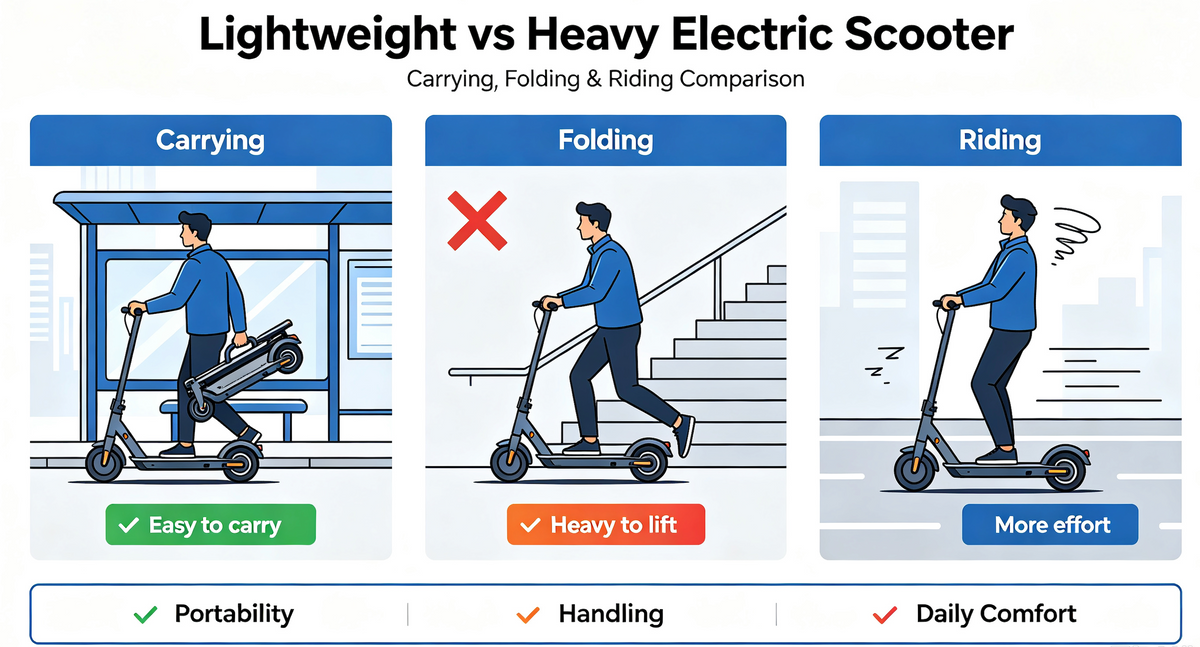
2. Portability: The First Difference You Notice
The easiest way to understand scooter weight is to imagine carrying one.
You may need to lift your scooter:
- Up apartment stairs
- Onto public transportation
- Into a car
- Into an office
- Through a shopping area
- Into a storage room
Even a relatively short carrying distance can make a significant difference when the scooter is used repeatedly.
For a rider who carries a scooter several times every day, portability may be more important than maximum motor power.
For someone who rides directly from home and stores the scooter in a garage, weight may be less important.
This is why the ideal scooter weight depends heavily on lifestyle.
3. Weight and Riding Stability
Weight also affects how a scooter feels on the road.
A heavier scooter can have a more substantial feel under the rider, particularly when combined with a longer deck, larger tires, and a robust frame.
This can be useful for riders who prioritize a planted riding experience.
A lighter scooter, meanwhile, can feel easier to maneuver and reposition.
The difference becomes especially noticeable when making tight turns, navigating crowded areas, or moving the scooter manually.

4. Why Performance Scooters Are Often Heavier
There is a reason high-performance scooters can become substantially heavier.
More powerful hardware generally requires more supporting components.
A larger battery can store more energy but also adds mass.
A more powerful motor adds hardware.
Dual-motor systems require additional drive components.
Larger brakes, suspension systems, stronger frames, and larger tires can also increase overall weight.
KuKirin's product range provides a useful example of this design philosophy.
A rider looking at models such as the G2, G2 Max, G2 Master, or G3 Pro will notice that scooters designed for different riding purposes can have significantly different physical designs.
The difference is not simply cosmetic.
The hardware required to support different performance levels affects the overall weight and dimensions of the scooter.
5. Battery Size and Weight
The battery is one of the most important contributors to electric scooter weight.
A larger battery can provide greater energy storage, but additional battery cells also add physical mass.
This creates a design trade-off.
More battery capacity can support longer-distance riding, but a larger battery can make the scooter heavier.
For long-distance riders, the additional weight may be worthwhile.
For commuters who carry the scooter into a building every morning, the trade-off may feel very different.

6. Motor Power Also Matters
Motor systems contribute to the same balance.
A scooter designed around a modest motor can often use a simpler overall architecture.
Higher-performance models may require more substantial motor hardware and supporting electronics.
Dual-motor scooters add another motor system, which naturally increases the amount of hardware involved.
KuKirin models such as the G2 Master and G3 Pro demonstrate how performance-oriented designs can incorporate more substantial drive systems.
For riders interested in performance, additional weight may be part of the package required to support the desired riding characteristics.
7. Weight and Daily Convenience
The most important question is what happens after the first week of ownership.
A scooter can be exciting during a test ride.
But ownership includes carrying, folding, parking, charging, storing, and transporting the scooter.
This is where weight becomes a practical issue.
Imagine two riders.
Rider A lives on the ground floor and keeps the scooter in a garage.
Rider B lives on the fourth floor and carries the scooter upstairs every evening.
The same scooter can feel completely different to these two people.
That is why weight should always be considered in relation to your daily routine.
8. Is a Heavier Scooter Always Better?
Not necessarily.
Weight itself does not determine whether an electric scooter is suitable.
A heavier scooter can provide a solid platform for larger batteries, motors, suspension, and other equipment.
But if the scooter is too heavy for your transportation needs, those advantages may come with a practical cost.
Similarly, an extremely lightweight scooter may be convenient to carry but may not provide the hardware or ride characteristics that a particular rider wants.
The goal is balance.
9. How to Choose the Right Weight
Before buying a scooter, ask yourself five questions:
1. How often will I carry it?
Daily carrying makes weight much more important.
2. Where will I store it?
Consider stairs, elevators, garages, and indoor storage.
3. How far will I ride?
Longer rides may justify a larger battery and more substantial construction.
4. What type of roads will I use?
Urban streets and rougher terrain may require different hardware.
5. What performance do I expect?
Higher performance can require additional components and therefore more weight.
Electric scooter weight is not simply a number printed in a specification table.
It is the result of design decisions involving the battery, motor, frame, suspension, tires, brakes, and electronic systems.
KuKirin's range demonstrates how different scooter designs can prioritize different combinations of portability, power, range, and riding capability.
The right question is therefore not whether a scooter is light or heavy.
The better question is whether its weight makes sense for you.
Because the best scooter is not necessarily the lightest one.
It is the one whose weight, performance, and practicality fit the way you actually ride.
Related reading:
👉 Click to view more content on our KuKirin Ride official website
👉KuKirin G2 (2026 New) Electric Scooter – 800W Motor, 55km Range, Smart Touchscreen Display
👉KuKirin G4 (2026 New) Electric Scooter – 2000W Motor, 75km Range, 70km/h Top Speed
👉KuKirin G2 Pro VMP (2026 New) Electric Scooter – EU Road Legal, 65km Range, 500W Motor
👉How the Controller Controls a KuKirin Electric Scooter Motor
👉KuKirin G2 Master: Built for Riders Who Demand Power, Comfort, and True Off-Road Freedom
Condividi:
How the Controller Controls a KuKirin Electric Scooter Motor